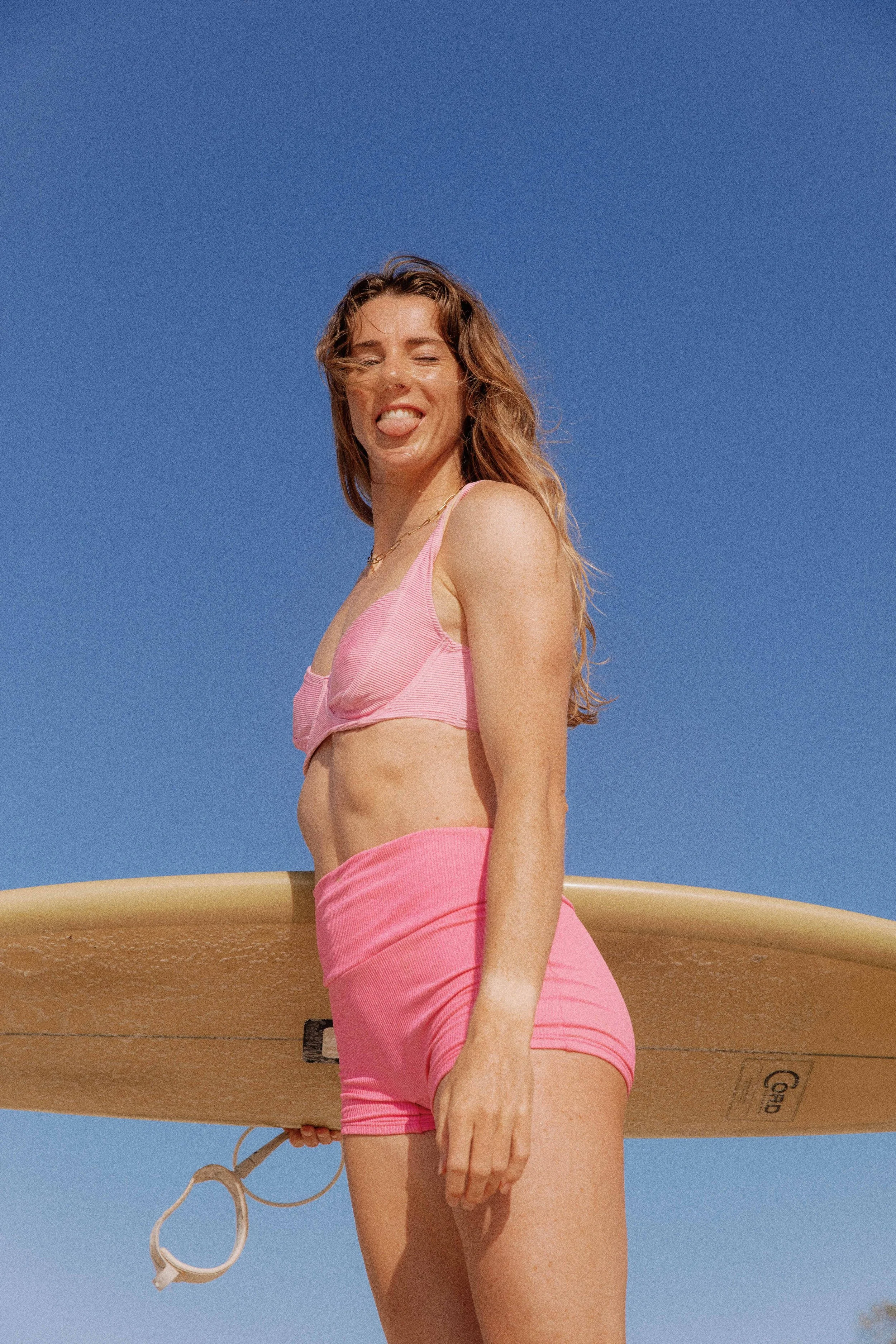
So you wanna know more about surfing?
Getting Started:
How long does it take to learn to surf?
Okay, let's get real about time. Like any sport learning to master it takes time. There's an initial phase of rapid progress – you know, the thrill of standing up for the first time. That might take one wave, 1 lesson or a few weeks, Everyone's different.
Then comes the long game:Building your ocean awareness: Understanding rips, tides, and how swells wrap around different breaks. This takes time in the water, observing and learning.
Developing your technique: Paddling efficiently, popping up smoothly every time, turning with control of the rails, reading the wave… these are skills you refine over years.
So, the short answer is: you can start surfing in a few lessons. But it depends what level you whats to get to, if you want to be able to ride green waves or eventually get barrelled its going to take time and commitment!
What size surfboard is best for a beginner?
Foam boards are your best friend. They're designed for stability and ease of paddling, which translates to more wave-catching and more fun. Here's why size matters:Length: Longer boards (7' and up) have more glide and are easier to paddle. They catch waves earlier, which gives you more time to get to your feet.
Width: A wider board provides more stability, both when paddling and when standing. This helps you balance and prevents you from tipping over easily. But will be harder to duck dive.
Thickness: More thickness means more volume, which translates to more floatation. This makes the board easier to paddle and catch waves.
Where are the best places to learn to surf?
The ideal learning spot has a few key ingredients:Gentle, consistent waves: You want to head to beaches that are easy to paddle into and won't throw you around too much.
Sandy bottom: you’ll start at waist to chest depth waver to you want to be able to walk out. Plus a soft landing really helps.
Safe conditions: No strong currents, rips, or hazards like rocks.
Surf schools: they'll have the right gear and instructors to get you started, teach you all about how to be safe in the ocean and good habits from the get go (which will save a lot of frustration trust me!) Feel free to have questions ready to ask your instructor, I’m sure they’ll be happy to help.
What does it cost to start surfing?
Prices range massively but Surfing does have a great 2nd hand market if your looking to get some bits to get you started, have a look on Facebook market place or the second hand rack at surf stores. You'll need a board (you can often rent at first), a wetsuit if it's chilly, and maybe some lessons. Surfing has a great 2nd hand market if your looking to get some bits to get you started have a look on Facebook market place or the second hand rack at surf stores.
If you opt for second hand you can probably pick up a wetsuit for $70 (USD) and a board for $100 but boards go up to $1000+. Lessons will be about $90
How do you stand up on a surfboard?
It’s called a pop up, It's the transition from lying down to surfing stance, it needs to be quick, smooth and you need to be consistently getting your feet in the right spot. Here's the breakdown:Paddle into the wave: Get that board moving fast enough for the wave to smoothly scoop you up.
Place your hands: As the wave starts to push you, place your hands flat on the deck, near your ribs. Avoid putting them around the rails as they could slip off.
Pop up: In one explosive movement, push up with your hands and bring your feet underneath you. Your back foot should land on or near the tail pad (or between the fins), and your front foot should land between your hands.
Find your stance: Bend your knees to absorb any wobble, keep your back straight, and look where you want to go.
Practice this on land a lot. Practice it until it's automatic. You eventually want to be able to do it without even thinking. You can practice at home by lying with a line right down your centre (tiles or wooden flooring are perfect)
Put your hands down on the floor by your chest, go to do a press up motion but explosive enough to bring your feet up under you into a surf stance.
You want to make sure that your feet are both planed in the centre of your line to make sure that you wont be tipping your board and falling in the water.
Technique and Equipment:
What are the basic surfing techniques?
Let's expand on those basics:Paddling: your going to be doing a lot of this. Efficient paddling is key to catching waves and getting around the lineup. Use long, smooth strokes, keeping your weight central on your board. Play with how far back on the board you lie- ideally you want the nose of the board to be about a fist hight out of the water for best glide and to avoid nose diving!
Popping up: We covered this one!
Riding the wave: Once you're up, it's about staying in the sweet spot on the board to keep your speed going the experimenting with leaning a little on to your rails to figure out directing the board.
Turning: This is where the fun really begins. Learning to hold your rail through turns means you can start to perform manoeuvres. There are different types of turns, like bottom turns, cutbacks, and snaps, each with its own purpose/ level of fun.
What are the different types of surfboards?
Longboards (9' and up): Classic and cruisy. They paddle easily, catch waves early, and are stable to ride. Perfect for smaller waves and mellow days.
Shortboards (under 7'): High-performance boards for more experienced surfers. They're designed for speed, and tight turns.
Mid length (7' to 8'): A versatile in-between option. They offer a good balance of stability and maneuverability, making them suitable for a range of conditions and skill levels.
Twin or single fin: Fast and loose, (less stable) can be any size. Ideal for having fun.
Gun - long pointy board for paddling into big waves.
Choosing the board you want to ride depends on your size, skill level, the type of waves you want to ride, and your personal style.
How do you read a surf forecast?
Okay, let's break down how to read a surf forecast. It might seem like a bunch of numbers and arrows at first, but once you get the hang of it, you'll be predicting perfect waves like a pro!Swell Size: This is the height of the waves (in feet or meters) out in the deep ocean. Keep in mind that the swell size can change as the waves travel to the coast and break. If your intermediate you’ll probably want waves below 4ft.
Swell Direction: This is where the swell is coming from. You'll see it in degrees (e.g., 180° is from the south) or compass directions (e.g., S for south, ESE for east-southeast). This is super important because it determines which breaks will be working. You’ll need too know which direction your beach faces to work out if the swell will be filling in there.
Swell Period: This is the time between waves, measured in seconds. A longer period (e.g., 10-15 seconds) means more powerful, clean waves with more energy. A shorter period (e.g., 5-7 seconds) means weaker, choppier waves.
Wind Direction and Strength: Wind can make or break a surf session. Offshore wind (blowing from the land out to sea) is our best friend – it grooms the waves and makes them clean. Onshore wind (blowing from the sea towards the land) can make the surf messy and choppy. Again you’ll need to note which direction your beach faces to know how the wind effects it.
Tide: Tides play a big role in how waves break. Some spots work best at high tide, others at low, and some in between depending on the ocean floor below them. Waves can be very different depending on the tide. It's always good to check a local surf guide or ask in the surf shop for the lowdown on your favourite break.
Local Knowledge: This is the golden nugget. Forecasts are a great starting point, but nothing beats knowing how your local breaks behave.
Where to Find Forecasts
I usually check a few different sources to get a well-rounded picture: surfline is a great place to start, theres also swellnet, windy and wind guru.What are the different types of surfboard fins, and how do they affect performance?
Fins are like the engine and steering system of your surfboard. They have a massive impact on how your board handles.Single fin: The classic setup, common on longboards. Provides stability and a smooth, predictable ride. Great for cruising and traditional surfing.
Twin fin: Two fins, often found on fish surfboards. They're fast and loose, offering a skatey feel and good maneuverability in smaller waves.
Thruster (3 fins): The most common setup on modern surfboards. It provides a balance of stability, control, and maneuverability. Versatile and works well in a wide range of conditions.
Quad (4 fins): Two fins on each side. Offers speed and drive, especially in down-the-line surfing. Can feel very fast and responsive.
Fin placement, size, and shape also play a role. Experimenting with different fin setups can really fine-tune your board's performance.
How do you generate speed on a surfboard?
"Speed = stability in surfing. It allows you to make it pastsections, perform maneuvers, and have more fun. Here's how to get it:
Paddling: Strong, efficient paddling gets you into the wave early and sets you up for speed from the start.
Pumping: Once you're on the wave, you use your legs to compress down the wave then extend up the wave - almost like you’re jumping along the wave. Your speed is coming from falling down the wave and the water rushing up the face.
Bottom turn: A good bottom turn is crucial. It's the foundation for generating speed and setting up your line on the wave. A smooth, powerful bottom turn will project you forward.
How do you perform a cutback?
The cutback is a fundamental turn that allows you to link into other moves. It’s how you stay in the pocket and avoid getting stranded on the shoulder and loosing all your speed. You are basically trying to carve a figure 8 in the wave.Approach: Set up your cutback with a shallow or mid-face bottom turn..
Body rotation: Rotate your upper body and engage your rail looking back to the white water, leading with your head and shoulders to start with then your hips will follow.
Rebound- hit the white water with the bottom of your board to gain speed, be careful not to get swallowed up by the whitewater.
More advanced- aim to the lip above the white water and ‘snap’ off it. As you approach the lip Quickly redirect your body to ride straight back down the wave. The bottom of your board should hit the lip and help to speed you up.
Safety and Etiquette:
What are the dangers of surfing? (e.g., rips, sharks)
The ocean is an incredible force, and with that comes potential risks.Rips: These are strong currents that can pull you out to sea. The most important thing is don't panic and don't swim against the current. Swim parallel to the beach until you're out of the rip, then swim back to shore.
Sharks: While shark encounters are rare, it's important to be aware. Avoid surfing at dawn or dusk, when sharks are most active, and avoid murky water or areas where there are a lot of baitfish.
Other hazards: Rocks, reefs, strong currents, and large waves can also be dangerous. Surf with friends, always assess the conditions before you paddle out, and don't surf beyond your ability.
What is the proper surfing etiquette?
Surfing has its own set of rules, and they're all about respect, safety and keeping it funPriority: The surfer closest to the peak or white water has the right of way.
Don't drop in: Never paddle into a wave front of someone who is already riding a wave.
Paddle wide: When paddling back out, paddle wide of the lineup, not through it so that you don’t mess up someone else’s wave by getting in their way.
Communicate: If you're unsure about something, ask.
Respect the locals: Be mindful of local surfers.
Leave no trace: Don't leave any trash on the beach or in the water.
How do you deal with a wipeout?
Wipeouts are inevitable, even for the best in the World and with the right mindset they can be part of the fun!Protect your head: Cover your head with your arms to protect it from your board and the reef or sand.
Relax: Try to relax your body as much as possible. Tension can tire you out quicker and use more oxygen.
Go with the flow: Let the wave take you where it wants to go. Don't fight it.
Surfing Life:
What is the best time of year to surf?
It depends on where you are and your level! Winter can be cold but there tends to be bigger waves. Summer usually has less swell but the water is warm- great for learning!
How do tides affect surfing?
Tides are caused by the gravitational pull of the moon. They significantly impact wave quality and how a wave breaks.High tide: Can make waves fuller and less likely to break, or it can make them break more gently on a shallow sandbanks.
Low tide: Can make waves break faster and more hollow, or it can make some spots too shallow to surf.
Incoming tide: Often the best time, as the water is pushing in and the waves are becoming more powerful.
Outgoing tide: Can sometimes lead to weaker waves, but it depends on the spot.
Who are some of the most influential surfers of all time?
Surfing has a rich history filled with incredible characters.Duke Kahanamoku was a a Hawaiian swimmer and lifeguard who was a major pioneer in surfing.
Kelly Slater is known as “the goat"‘; greatest of all time. 11 x world champion he is of of the most recognised faces in surfing.
Layne Beachley, 7 x womens world champ, was one of the key surfers that changed way that females are viewed in the sport.
Stephanie Gilmore over took Layne for most world tour wins, taking 8 titles known for her smile and style in the water.
Carissa More; Multiple times world champion and first ever olympic gold medalist.
What are some surfing slang terms?
Surfing, like any subculture, has its own language. Here are a few to get you started:"Barrel/Tube:" The hollow part of a wave.
"Grom:" A kid
‘Duck dive’- push under the wave to get out passed it.
"Stoked:" Excited or happy.
“Pitted or barrelled " riding inside a hollow wave.
"Wipeout:" Falling off your board.
"Lineup:" The place where surfers wait to catch waves.
“A Drop in:" when one surfer burns the other
“Dropping in” traveling down the face of a wave.
What are the psychological benefits of surfing?
Surfing is so much more than just a sport; that massively impacts your well-being.Stress reduction: The combination of physical activity, being in nature, and being in the moment melts away stress.
Mindfulness: Surfing requires you to be fully present in the moment, focusing on the wave and your body. This can cultivate mindfulness and help you escape the worries of everyday life.
Connection with nature: Surfing connects you with the raw power and beauty of the ocean, creating a sense of awe and gratitude.
Sense of accomplishment: Learning to surf, progressing and ticking off small goals can boost your confidence and self-esteem.
Community: Surfing is a social sport, and the shared experience of riding waves creates a strong sense of community and belonging.